Undertone Guide
Vein Color and Undertone:
What Blue, Green & Purple Veins Mean
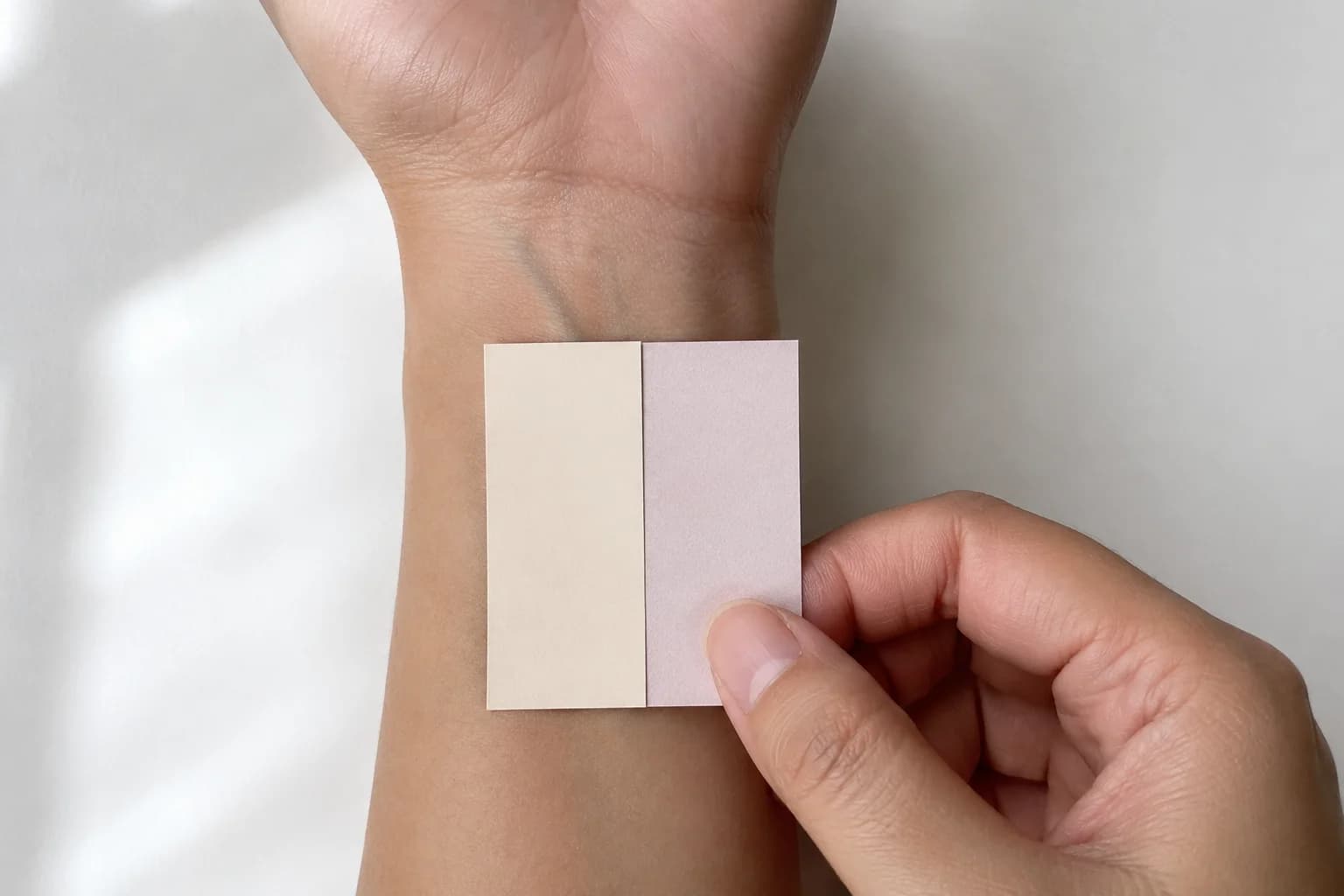
Look at your wrist in daylight and you'll see a color. What that color actually tells you, and where it lies to you, is a longer story than "blue means cool."
Why the Vein Test Actually Works
This isn't folklore. Veins carry deoxygenated blood, which really is dark red, but skin scatters light unevenly by wavelength before it reaches your eye. Thinner or more yellow-toned skin lets more of the green-yellow wavelengths through, so the vein reads green. Skin with less yellow pigment lets more blue through relative to green, so the same vein reads blue. You're not looking at the vein's real color. You're looking at your own skin's filter.
That's exactly why the test is useful and exactly why it isn't the whole answer. It's measuring a real, physical property of your skin, not a guess. But it's one signal read through a lot of variables, which is why the rest of this guide spends more time on the exceptions than the rule.
Blue or Purple Veins → Cool
If your veins read clearly blue, or deep enough to call purple, that's a cool undertone. Purple isn't a separate result from blue, it's blue on the darker end, and both point the same direction. This is the most stable of the four readings: cool veins rarely get mistaken for anything else once you're looking in natural daylight.
Pair it with the jewelry test to confirm. Cool skin tends to look more awake next to silver than gold. If both agree, you can stop testing.
Green Veins → Warm
A green reading is a warm undertone. It's also the most common single reading, since warm undertones outnumber the other three categories in most populations. If your veins look green under a normal window's daylight, not a phone flashlight or an overhead bulb, that's warm.
Confirm it with the jewelry test the same way: warm skin generally looks more awake next to gold than silver.
Olive, Green-Brown, or Just Hard to Call → Olive
This is the reading most guides skip, and it's a real category, not a failed test. If your veins look olive or green-brown, or the color flat-out refuses to sort into a clean blue or green, that's usually an olive undertone: warm and cool pigment overlapping in the same skin instead of one winning out.
The tell that separates olive from a true neutral is the jewelry test. Olive skin still usually has a lean, gold tends to look best but silver can look faintly gray or muddy rather than simply "a little less flattering." A true neutral won't show that gray cast either way.
A Genuine Blue-Green Mix → Neutral
Neutral looks different from olive on the wrist. Where olive reads as its own distinct greenish cast, a neutral reading is a real, even split, some veins or parts of a vein look blue, others look green, with no gray or muddy quality pulling it toward olive. It's genuinely a coin flip, not a compromise color.
The confirming test here is jewelry again: if gold and silver both look about equally good, not "both fine but gold edges it," you're looking at neutral rather than a mild lean toward warm or cool.
Want a straight answer instead of cross-referencing four sections?
Take the undertone quiz →What About Purple-and-Green, or All Three at Once?
A lot of people search for exactly this: their wrist shows purple in one spot, green in another, maybe a third vein that looks like neither. That's not a fifth category. It almost always means one of two things: the lighting is inconsistent across the small area you're checking, or you're genuinely close to a border between two undertones and no single vein is going to settle it.
Either way, the fix is the same: stop looking for more vein detail and run a different test. The jewelry test and the sun-reaction test measure different things (metal reflectance and how your melanin responds to UV, not light passing through skin), so they won't share the vein test's specific blind spots. Two tests that disagree on method but agree on an answer are far more trustworthy than one test you've stared at five times.
The Test Gets Harder on Very Fair or Very Deep Skin
On very fair skin, veins can look almost too blue, sometimes closer to teal or turquoise, simply because there's so little pigment filtering the light that the true vein color comes through with less distortion. That's still a cool reading, just a more saturated version of it.
On deep skin, the opposite problem shows up: veins read faintly, or barely visible at all, because more melanin means more light gets absorbed before any color reaches your eye. This is the single biggest reason the vein test frustrates people with deep skin tones specifically, and it's not a flaw in your skin, it's a limit of the test. If your veins are hard to read regardless of lighting, weight the other four tests more heavily rather than squinting harder at your wrist.
Pair It With the Other Four Tests
The vein test is one of five reliable signals, not the only one. Jewelry, sun reaction, the white paper test, and how your last well-matched foundation was labeled all catch things the vein test misses, and a result that shows up in three or four of them is worth far more than a single confident-looking vein.
Frequently Asked Questions
Purple usually just means "solidly blue, on the deep end," so treat it the same as blue and call it cool. It only gets ambiguous if it's paired with a real green cast elsewhere on the wrist, in which case run the jewelry and sun-reaction tests before deciding.
Not reliably by itself. A true neutral reading is when you genuinely cannot call a color, not blue-ish or green-ish but a real toss-up. If you can name a direction at all, even a slight one, that's your answer. Neutral is a real category, but it should be a conclusion from multiple tests agreeing on "no clear winner," not a guess from one glance at your wrist.
Yes. Veins read faintly on deep skin because there's more pigment for the light to pass through before it reaches your eye, so the color signal is naturally weaker. That doesn't mean the test fails, it means you should lean harder on the other four tests (jewelry, sun reaction, white paper against the inner arm, foundation match) rather than expecting the vein test to carry the whole answer.
It's a reasonable starting signal, not a verdict. Lighting, a recent tan, and skin depth can all shift how a vein reads without your actual undertone changing at all. Treat it as one data point out of five and look for agreement across at least two or three before you commit to an answer.
Free · 30 seconds
Skip the Wrist-Squinting
Our free undertone quiz runs the vein test alongside the other four in under a minute and gives you a straight answer: warm, cool, neutral, or olive.
Take the undertone quiz →