Color Analysis Guide
The Color Wheel
and Your Color Season
"Color wheel" and "color season wheel" get used interchangeably, but they're two different diagrams answering two different questions. Both are below, fully labeled, not just for decoration.
The standard color wheel: warm, cool, complementary, analogous
This is the twelve-hue wheel taught in any color theory class: red, yellow, and blue as primaries, orange, green, and violet filling the gaps as secondaries, then a tween hue between each pair. Arranging it as a circle instead of a strip is what makes two relationships visible at a glance instead of something you have to describe in words.
Complementary colors sit directly opposite each other, marked below with a dashed line — red and green, in this example. They create the most contrast. Analogous colors sit next to each other, marked with the curved line — blue, blue-violet, and violet. They blend the most naturally.
The seam between Red-Violet and Red, and the seam between Yellow and Yellow-Green, are the two points where color theory draws the warm/cool line — reds, oranges, and yellows on the warm side; greens, blues, and violets on the cool side.
Where your own coloring sits on it
Skin, hair, and eyes aren't paint chips, but the pigment in all three carries the same warm-or-cool quality a swatch does. A golden, peachy, or yellow-based undertone reads as warm, the same family as the wheel's reds, oranges, and yellows above. A pink, blue, or ash-based undertone reads as cool, the same family as its greens, blues, and violets.
This is why a vein test or a gold-versus-silver check works as a rough undertone read: you're not learning a new fact about your skin, you're figuring out which half of the wheel above you already belong to. Hair and eye color carry the same undertone signal, which is part of why undertone is the first thing any color analysis measures — see the 5 at-home undertone tests for how to check yours.
The season wheel: a different diagram, not the same one
A "color season wheel" isn't the twelve-hue wheel above with season names taped onto the segments — hue alone doesn't determine season, since a season can include the warm or cool version of nearly any hue at the right depth and chroma. The season wheel is its own diagram, built from two different axes: temperature (warm to cool) on one, chroma (clear to muted) on the other.
Undertone puts you on the right or left half. Chroma, how clear and saturated versus soft and greyed your natural coloring reads, puts you on the top or bottom half. Cross the two and you get four quadrants, one per season:
Spring is warm and clear. Autumn is warm and muted — same undertone as Spring, opposite chroma. Winter is cool and clear. Summer is cool and muted — same undertone as Winter, opposite chroma. A 16-season system just adds a third axis, depth, and splits each quadrant into four narrower bands instead of one.
A few brands sell this as a physical product too, usually a printed disc with a rotating dial: match your undertone, spin the dial, and it points to the complementary or neutralizing colors on the opposite side. Same underlying logic as the diagram above, just packaged as a tool you buy rather than a chart you read.
Using both wheels to pick colors
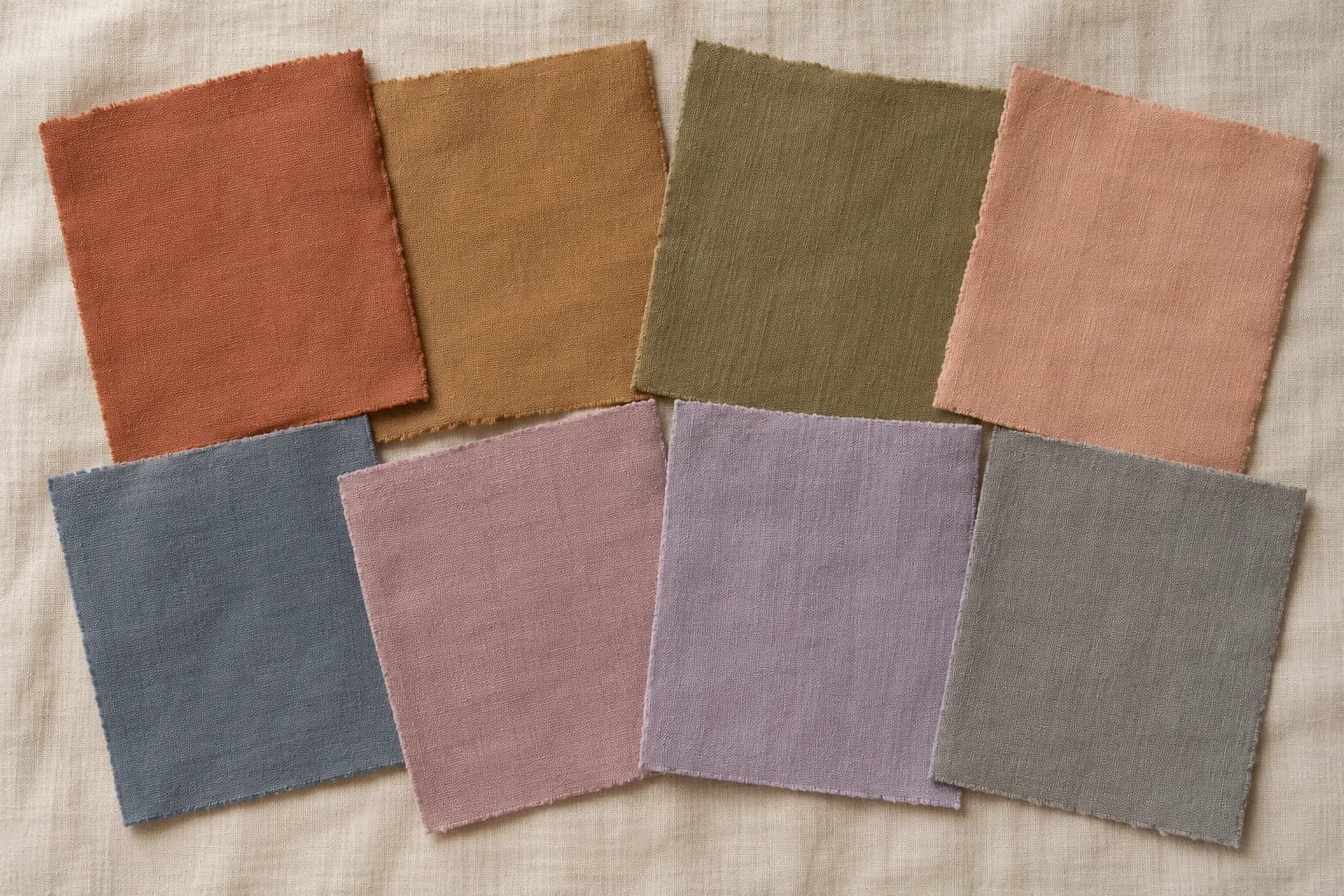
Once you know your season, the hue wheel's analogous colors, the neighbors on your side, are close to foolproof. A Soft Autumn moving from dusty terracotta to olive to warm ochre is staying within one continuous, warm-and-muted stretch of the wheel.
True complements are trickier, because the opposite side of the hue wheel is usually the opposite temperature too. A small dose, one accent piece against a season-appropriate base, can read as intentional. Two large, equal pieces from opposite sides tend to fight each other, since one of them is working against your own undertone no matter how the rest of the outfit is styled.
None of this requires memorizing either wheel. It's color theory applied to your own coloring, and a quiz that scores undertone, depth, chroma, and contrast does the placement on both for you.
Frequently asked questions
What is a color season wheel?
A color season wheel plots the four color analysis seasons on two axes instead of twelve hues: warm versus cool across one axis, clear versus muted across the other. That produces four quadrants — Spring (warm, clear), Autumn (warm, muted), Summer (cool, muted), and Winter (cool, clear) — a different diagram from a standard hue wheel, even though people often picture one when they hear the other.
How does skin tone fit into the color wheel?
Skin, hair, and eye pigment carry the same warm-or-cool undertone that a paint chip or fabric swatch does, so they read as sitting on one half of the wheel or the other. A warm, golden undertone sits with the reds, oranges, and yellows; a cool, pink or blue undertone sits with the greens, blues, and violets. That placement is the main thing that decides which colors from the wheel flatter you.
What is a "skin tone color wheel" tool, and do I need one?
A few brands sell a physical skin tone color wheel: a printed disc with a rotating dial you turn to your matched undertone to reveal complementary and neutralizing colors on the opposite side. It's a paper version of the same logic on this page — undertone plus the wheel's opposite-side relationship. Useful as a quick reference, but not required; a quiz that scores undertone, depth, chroma, and contrast gets you the same placement without buying a tool.
Are complementary colors always a safe combination?
Not for clothing the way they are for graphic design. True complements sit on opposite sides of the wheel, which usually means one warm and one cool — fine as a small, deliberate accent, but risky as two equal-sized pieces since one half will clash with your own undertone. Analogous colors, the ones next to each other on the wheel, are the safer default while you're still learning your palette.
Do I need to know color theory to find my color season?
No. The color wheel and the season wheel explain why seasonal color analysis works, but you don't need to study either one to get a result. A quiz that scores your undertone, depth, chroma, and contrast places you on both wheels for you — the theory is useful background, not a prerequisite.
Free · 3 minutes · No signup
Find Your Place on the Wheel
Take the free quiz and get your exact color season — undertone, depth, chroma, and contrast, scored for you.
Take the free quiz →